Have a Question about JIIT?
Chat with VIDYA
Chat with VIDYA
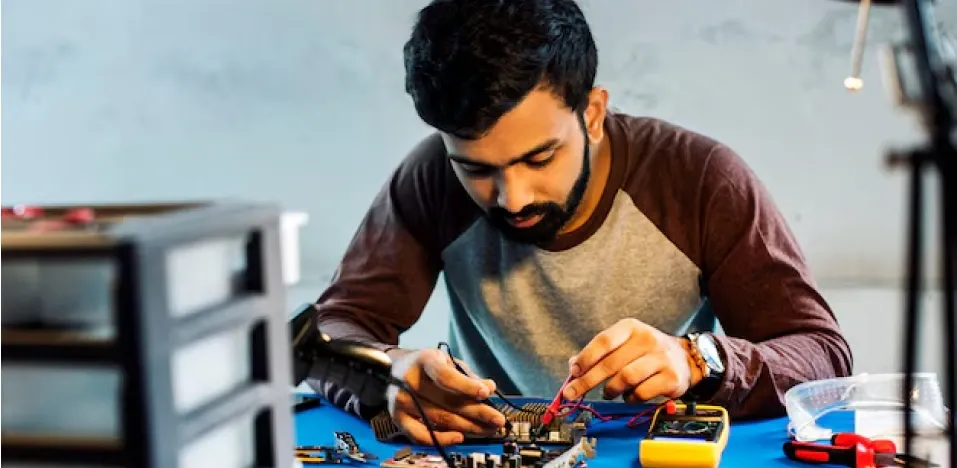


The conversation around engineering college entrance in 2026 now focuses not just on degree selection but also on relevance. And right now, nothing is shaping the future of engineering quite like semiconductors. Semiconductors are the core of contemporary innovation, from smartphones to electric vehicles, AI systems, and even national security infrastructure.
This is more than a global trend; it is a national priority. Launched 3 years ago, the India Semiconductor Mission (ISM) is a visionary initiative by our Prime Minister with the goal of creating a thriving semiconductor ecosystem in India. For students entering or planning to enter the field, this mission is creating a massive demand for domestic expertise in chip design and fabrication.
Semiconductors are materials that allow electronic components to control current. With every new digital advancement, the demand for faster, smaller, and more efficient processors continues to grow. That’s why a career in India’s semiconductor industry is seen as both strategic and future-proof. Whether it is chip design, testing, fabrication, or system integration, this is one of the most in-demand fields today.
Semiconductor technology cuts across multiple disciplines, not just one branch of engineering.
We advise our students not to limit themselves by branch names; the real opportunity lies in the intersection of disciplines. To support this, JIIT has established B.Tech and M.Tech programs with a dedicated focus on VLSI design. These programs are backed by infrastructure aligned with the national vision, providing students the opportunity to gain hands-on proficiency through our specialised, state-of-the-art VLSI fabrication and characterisation lab.
The semiconductor space requires a unique level of thinking. It is more than writing codes or understanding circuits at a basic level, but about efficiency and precision, where even the smallest error matters.
Key skills include:
Besides the skills, while learning semiconductors, students can gain exposure to programming, system design, and real-time experimentation. The goal is to develop a mindset that prioritises deep understanding of how systems work, not just how to use them.
We at JIIT oftenemphasise this early: the industry doesn’t just reward knowledge; it rewards understanding.
According to industry predictions, the semiconductor job market presents enormous growth potential across all skill levels. According to McKinsey & Company, there will be over 160,000 new engineering and technician positions by 2032. This growth translates to approximately 88,000 semiconductor engineering jobs by 2029.
Today’s market reveals significant opportunities:
Entry-level positions: Despite industry concerns about reduced entry-level semiconductor jobs, specific niches show strong demand for newcomers with relevant technical skills.
Specialised technical roles: Due to a shortage of talent, advanced packaging engineers, photonics specialists, and AI integration specialists command high salaries.
Manufacturing support: New fabrication facilities and reshoring initiatives support roles like equipment technicians, module operators, and process engineers.
Design Engineering: As chip complexity rises, there is a strong demand for verification engineers, analogue designers, and system architects.
The talent gap creates a unique advantage for students planning to enter the field.
At JIIT, we see this transformation influencing how engineering education is delivered. The focus is gradually shifting from theoretical teaching to a more research-oriented approach.
Students are encouraged to engage in interdisciplinary learning, work on real-world problems, and explore emerging innovations. This kind of environment helps bridge the gap between industry expectations and academic learning.
Semiconductors are now shaping the direction of the entire field. For students planning their next step, this is a moment to think ahead. To begin this journey, start by understanding the engineering admission criteria at JIIT. Because the right start determines how far one can go.
The future will belong to engineers who don’t just adapt to change but anticipate it.
Apply now:
https://getadmissions.com/jaypee

 Old Website