Have a Question about JIIT?
Chat with VIDYA
searchImportant Announcements:
Admissions Open for 2026.Apply NowAnother Opportunity : Open House (Parent Interaction) on 13th June 2026.Register NowCareer OpeningsApplyRound-1 of 10+2 Marks Based Counselling Scheduled for 03 June 2026. Instructions
Undergraduate

B.Tech in Electronics Engineering - VLSI Design and Technology

B.Tech
Electronics Engineering - VLSI Design and Technology

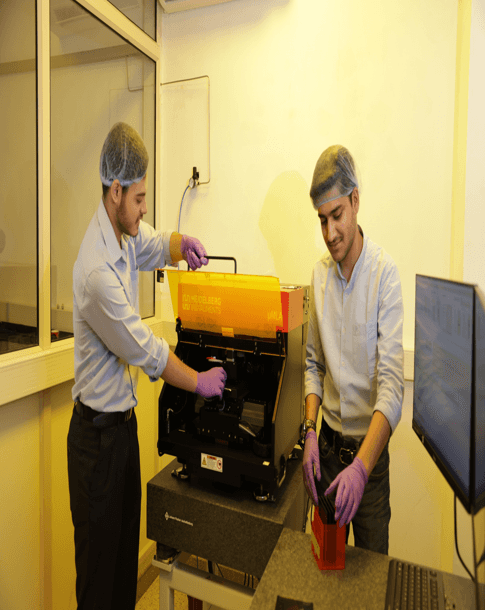
The B.Tech. in Electronics Engineering (VLSI Design and Technology) is a comprehensive program designed to equip students with strong foundations in electronics, semiconductor technology, and advanced VLSI systems. Spanning eight semesters and 160 credits, the curriculum balances theoretical learning, laboratory practice, and project-based application to prepare graduates for roles in design, verification, fabrication, and testing. The program begins by establishing a robust base in mathematics, physics, programming, and core electronics, supported by structured laboratory sessions. This ensures that students gain both analytical strength and practical skills early in their journey. Alongside technical training, courses on professional communication, life skills, and human values contribute to well-rounded professional development. Progressing further, students delve into key areas such as signals and systems, digital logic, analog and digital communication, and microfabrication technology. Practical exposure is emphasized through specialized laboratories, micro-projects, and design lifecycle labs, enabling students to bridge classroom learning with industry-standard practices.

At the heart of the program lies a strong focus on semiconductor devices and materials, microcontrollers, computer architecture, control systems, and embedded technologies. Through dedicated labs, students gain hands-on experience in device characterization, circuit design, and prototyping, ensuring they are well-versed with modern design flows. The advanced stages of the program concentrate on VLSI design, verification, and testing, supported by labs and minor projects that simulate real-world chip design and validation workflows. Electives in open, departmental, and discipline-specific domains provide flexibility to tailor expertise, while major projects encourage integration of knowledge across domains into deployable solutions. Graduates of this program emerge with industry-ready expertise, capable of contributing to semiconductor industries, EDA tool development, embedded systems, IoT applications, and fabrication-driven technologies, making them valuable professionals in the rapidly evolving global semiconductor ecosystem.


Curriculum Structure
First Semester
S.NoCourse CodeCourse TitleLTPTotalCredits
115B11MA111Mathematics-131044
215B11PH111Physics-131044
315B11CI111Software Development Fundamentals-131044
415B11HS112English10232
515B17PH171Physics Lab-100221
624B15CS111Software Development Fundamentals Lab-100221
718B15GE111Engineering Drawing & Design00331.5
824B11EC111Basic Electronics31044
924B15EC111Basic Electronics Lab00221
Total2822.5
Second Semester
S.NoCourse CodeCourse TitleLTPTotalCredits
115B11MA211Mathematics-231044
215B11PH211Physics-231044
315B11CI211Software Development Fundamentals-231044
415B17PH271Physics Lab-200221
524B15CS121Software Development Fundamentals Lab-200221
624B16HS111Life Skills & Professional Communication Lab0022Qualifying
718B15GE112Workshop00331.5
824B11HS111Universal Human Values (UHV)21033
Total2418.5
Third Semester
S.NoCourse CodeCourse TitleLTPTotalCredits
115B11MA301Probability and Random Processes31044
224B21EC211Electronic Devices30033
324B25EC211Electronic Devices Lab00221
418B11EC214Signals and Systems31044
525B21EC211Digital Logic and Circuit Design30033
625B25EC211Digital Logic and Circuit Design Lab00221
719B13BT211Environmental Studies3003Qualifying
824B27EC211Micro Project-100442
924B11MA211Numerical Techniques20022
1015B11HS211Economics21033
Total3023
Fourth Semester
S.NoCourse CodeCourse TitleLTPTotalCredits
125B21EC212Analog Electronic Circuits30033
225B25EC212Analog Electronic Circuits Lab00221
325B21EC213Discrete Signal Processing30033
425B21EC214Communication Engineering30033
524B21EC212Introduction to Microfabrication Technology30033
624B25EC212Introduction to Microfabrication Lab00221
724B25EC213Introduction to VLSI Lifecycle Lab00221
824B27EC212Micro Project-200442
915B1NEC733Fundamentals of Embedded Systems30033
10xxxxxxxxxHSS Elective–121033
Total2823
Fifth Semester
S.NoCourse CodeCourse TitleLTPTotalCredits
1xxxxxxxxxHSS Elective-230033
224B21EC311Semiconductor Materials Synthesis and Characterization30033
3xxxxxxxxxDiscipline Elective -1*30033
418B11EC312Electromagnetic Field Theory31044
518B15EC312Electromagnetic Field Theory Lab00221
615B11EC613Control Systems30033
724B21EC312Microcontrollers and Computer Architecture30033
824B25EC312Microcontrollers and Computer Architecture Lab00221
915B19EC591Minor Project – 100442
1020B13HS311Indian Constitution & Traditional Knowledge3003Qualifying
Total3023
Sixth Semester
S.NoCourse CodeCourse TitleLTPTotalCredits
117B1NEC736Essentials of VLSI Testing30033
218B15EC313Embedded Systems/IoT Lab00221
3xxxxxxxxxDiscipline Elective -2*30033
4xxxxxxxxxDiscipline Elective -3*30033
524B12EC313Digital CMOS VLSI Design30033
618B15EC315VLSI Design Lab-II00221
7xxxxxxxxxOpen Elective - 130033
8xxxxxxxxxSelected Value Added Course2002Audit
924B25EC313VLSI Verification and Testing Lab00221
1015B19EC691Minor Project - 200442
11xxxxxxxxxDiscipline Elective -4*30033
Total3023
Seventh Semester
S.NoCourse CodeCourse TitleLTPTotalCredits
1XxxxxDiscipline Elective – 5*30033
2XxxxxDiscipline Elective –6*30033
3XxxxxOpen Elective - 230033
415B19EC791Major Project Part-100884
515B19EC793Summer Training Viva0000Qualifying
Total1713
Eighth Semester
S.NoCourse CodeCourse TitleLTPTotalCredits
1XxxxxDiscipline Elective - 7*30033
2XxxxxOpen Elective - 330033
324B17EC412Major Project Part-20016168
Total2214

* Discipline electives may run in 3 0 0 or 2 0 2 (L T P ) mode as per requirement of subject

Total Credits for B.Tech. –160

Frequently Asked Question
What part of chip design is covered in this programme at JIIT?
The programme covers the full VLSI lifecycle, including design, fabrication, verification, and testing, giving students a comprehensive understanding of chip development.
What kind of hands-on fabrication exposure is provided at JIIT?
What scholarship opportunities are available at JIIT?
Which VLSI-focused centres support this programme at JIIT?
How does JIIT provide fabrication-level exposure in the VLSI programme?
Are you ready to take the next step in your career ?
Fulfill your dreams by being a part of JIIT


Are you ready to take the next step in your career ?